DuPont Analysis: Breaking Down ROE
Two companies can earn the same return on equity in completely different ways. DuPont analysis shows which lever is doing the work.
DuPont analysis splits return on equity into profit margin, asset turnover and financial leverage, so you can see whether a high ROE comes from pricing power, efficiency or borrowing. The five-step version splits the margin further into the tax burden, the interest burden and the operating margin. The question it answers is not how high ROE is, but how it is made, and whether that can last.
 Geoff Robinson · Updated November 26, 2026 · Video and article
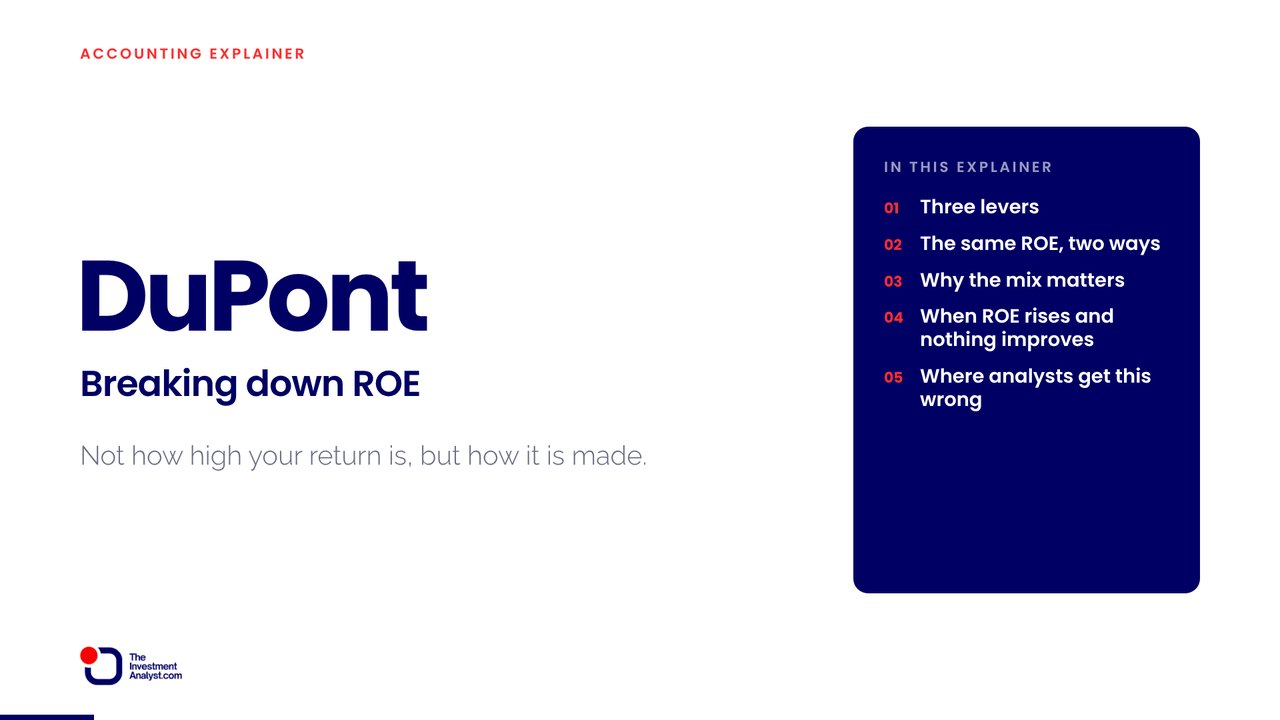
DuPont analysis. Breaking down return on equity, to see not how high it is, but how it is made.
Return on equity is net income divided by shareholders' equity. DuPont analysis splits it into three levers that multiply back to the same answer: the profit margin, the asset turnover, and the equity multiplier, which measures leverage.
Take two companies, each earning 15% on equity. The luxury brand earns it through pricing power, with a 15% margin and little debt. The discount retailer has a 2.5% margin, turns its assets over three times as fast, and borrows twice as much. The same fifteen percent, built from completely different levers.
The mix tells you about risk. If demand falls and margins slip, the retailer's leverage amplifies every point it loses. A return built on borrowing can reverse much faster than one built on pricing.
Leverage can lift ROE with nothing else changing. A company earns 75 on equity of 400: an 18.75% ROE. It borrows 200 at 5% and buys back shares. Net income falls to 67.5, equity halves to 200, and ROE jumps to 33.75%. The business is no better. It is just riskier.
Where analysts get this wrong. Praising a high ROE before asking which lever made it. Crediting management for a rise that came from a buyback. And relying on ROE when equity is tiny or negative, when return on invested capital tells you far more.
Margin, turnover, leverage. The same ROE can carry very different risks. Ask how it is made.
Three levers behind ROE
Return on equity is net income divided by shareholders' equity. On its own it tells you how much a company earns on its owners' money, not how. DuPont analysis multiplies three ratios that cancel back to ROE, and each one is a different lever.
Profit margin is how much of each dollar of revenue becomes net income. Asset turnover is how much revenue each dollar of assets produces. The equity multiplier, assets divided by equity, measures how much of those assets are funded by debt rather than by shareholders.
Worked example: the same ROE, built two ways
Two illustrative companies, each with a 15% return on equity
| Luxury brand | Discount retailer | |
|---|---|---|
| Profit margin | 15.0% | 2.5% |
| Asset turnover | 0.80x | 2.40x |
| Equity multiplier | 1.25x | 2.50x |
| Return on equity | 15.0% | 15.0% |
The luxury brand earns its return through pricing power, with little debt. The discount retailer earns the same return on thin margins, by turning its assets over three times as fast and borrowing twice as much. A fall in demand would hurt the retailer far more: its leverage amplifies every point lost in margin.
The five-step version
The five-step version splits the profit margin into three parts: the tax burden (net income over pre-tax income), the interest burden (pre-tax income over operating income, EBIT) and the operating margin (EBIT over revenue). It separates what operations earn from what financing and tax take away.
| Illustrative company | Ratio | Calculation |
|---|---|---|
| Tax burden | 0.75 | 75 / 100 |
| Interest burden | 0.83 | 100 / 120 |
| EBIT margin | 12.0% | 120 / 1,000 |
| Asset turnover | 1.25x | 1,000 / 800 |
| Equity multiplier | 2.00x | 800 / 400 |
| Return on equity | 18.75% | 75 / 400 |
Revenue 1,000, EBIT 120, interest 20, tax 25, net income 75, assets 800 and equity 400. The three-step version gives the same answer: a 7.5% margin, times 1.25 times turnover, times 2.0 times leverage, is 18.75%.
When ROE rises and nothing improves
Because leverage is one of the levers, ROE can rise without the business getting any better. Suppose the company borrows 200 at 5% and spends it buying back its own shares. Interest of 10, after tax relief, takes 7.5 off net income, which falls to 67.5. Equity halves to 200.
Return on equity jumps from 18.75% to 33.75%. Margins, turnover and the operations are exactly as they were; the company is simply riskier. That is why analysts look at return on invested capital, which is not changed by how the business is financed, alongside ROE.
Where analysts get this wrong
- Celebrating a high ROE. First ask which lever made it. A return built on leverage is a return built on risk, and it can reverse faster than one built on margins.
- Missing the buyback effect. A debt-funded buyback can lift ROE by fifteen points while the business stands still. Check the equity multiplier before you credit management.
- Using year-end equity. Average equity over the year matches the earnings, which were made across the year. Year-end figures distort ROE when equity changes sharply.
- Ignoring negative or tiny equity. After years of buybacks some companies have very little equity, and ROE becomes meaningless. Switch to ROIC.
Test yourself
Two companies both report a 15% ROE. Company A has a 15% profit margin and little debt; Company B has a 2.5% margin, high asset turnover and an equity multiplier of 2.5 times. Which statement is right?



Related explainers
The fund with the higher return is not always the better fund.
One is measured in years, the other in percent.
The biggest number you control least.
One measures how fast your money grew, the other how much of it you made.
Frequently asked questions
What is DuPont analysis?
A way of splitting return on equity into profit margin, asset turnover and financial leverage, so you can see whether a company's ROE comes from pricing power, efficiency or borrowing.
What is the DuPont formula?
ROE = net income / revenue × revenue / assets × assets / equity. The five-step version splits the margin into the tax burden, the interest burden and the EBIT margin.
Why use the five-step DuPont model?
It separates operating performance (the EBIT margin and asset turnover) from the effects of financing and tax, so you can see whether a change in ROE came from the business or from its capital structure.
Can buybacks increase ROE?
Yes. Buying back shares with debt shrinks equity and raises leverage, so ROE rises even if the business is unchanged. In the worked example ROE rises from 18.75% to 33.75%.
Former UBS Managing Director. 10× No.1 in the EMEA Institutional Investor Survey. One of eight people worldwide to hold the Master of Financial Modelling designation.