Terminal Value: Gordon Growth vs Exit Multiple
The biggest number you control least. Most of a DCF's value sits in a figure analysts reach for last and scrutinize least.
Terminal value is usually the largest part of a DCF yet the most casually set. The Gordon growth formula capitalizes every cash flow beyond the forecast, is hypersensitive as growth nears the discount rate and must be capped at long-run GDP growth. An exit multiple prices the business at the end of the forecast instead: use it to test your growth and return assumptions.
 Geoff Robinson · Updated November 26, 2026 · Video and article
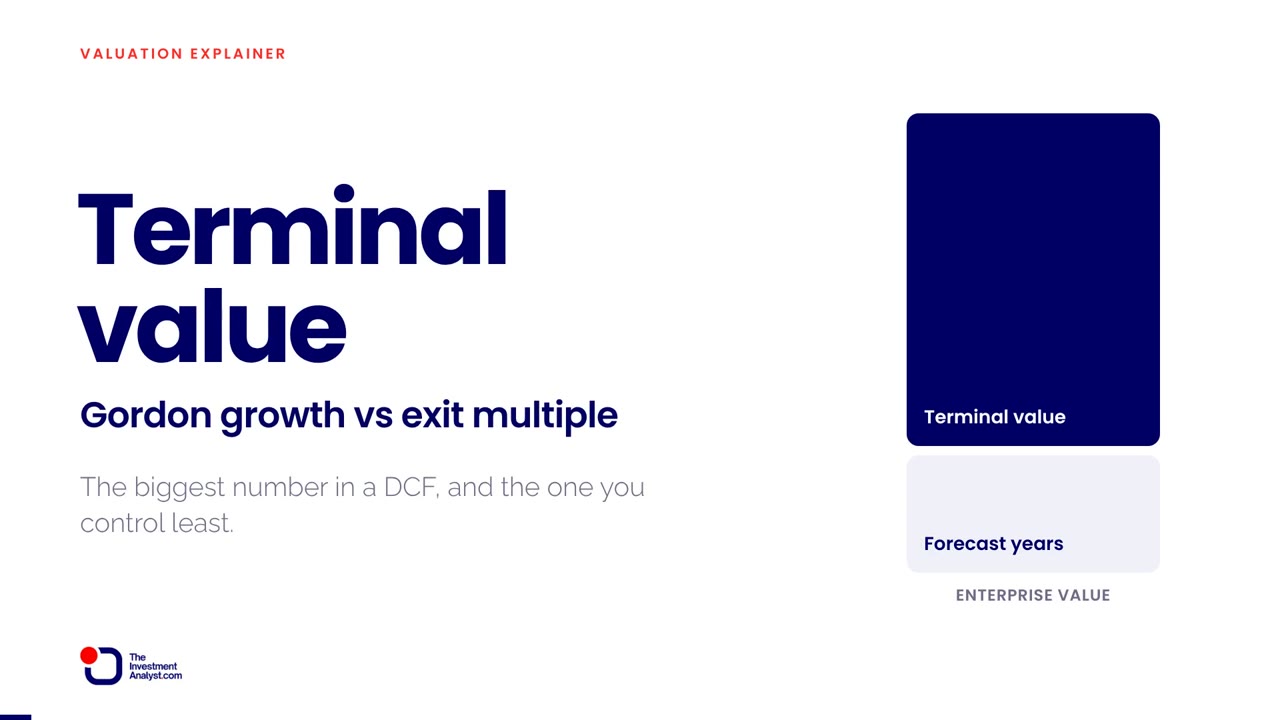
Terminal value. The biggest number in a DCF, and the one you control least.
A DCF can't forecast every year forever, so it splits the future in two. The years you model, then one figure that stands in for every cash flow after them. In Ravelstone Foods' valuation, that one figure is 74% of enterprise value. Its assumptions aren't a footnote. They are the valuation.
The Gordon growth formula divides next year's free cash flow by the cost of capital minus growth. That puts growth in the denominator. As g moves toward the cost of capital, the gap shrinks toward zero, and the terminal value explodes.
Ravelstone's final-year free cash flow is $860 million, and its cost of capital is 6.9%. At 2% growth, the terminal value is $17.9 billion. At 3%, it's $22.7 billion, up 27%. At 4%, $30.8 billion, up 72%. Nothing about the business has changed. One number near the edge of the denominator moved.
An exit multiple works differently. It prices the business at the end of the forecast, on what comparable companies trade at. The value driver formula, with 3% growth and a 20% return on new capital, gives $22.1 billion. Gordon growth gives $22.7 billion. Fourteen times trailing EBITDA, the comparables' multiple, gives $25.3 billion. Fourteen percent more.
That gap tells you what the multiple is assuming. The value driver answer implies 11.9 times forward EBITDA, about a quarter below Ravelstone's 15.6 times today. Paying 14 times assumes 3.6% growth forever at the same returns, or a 109% return on new capital at 3% growth. Use the multiple to test the perpetuity, not to replace it.
Four mistakes come up again and again. One: treating g as a free lever. Half a point feels trivial and can swing most of the value. Two: letting g outrun the economy. Cap it at long-run nominal GDP growth. Three: a cliff, not a fade. Fade growth and returns before the terminal value takes over. Four: growth that isn't paid for. Use the value driver form, so growth costs reinvestment at a return you can defend.
Terminal value is where most of the value sits, so check it first, not last. The free worksheet and cheat sheet are on theinvestmentanalyst.com.
Why terminal value dominates
A DCF cannot forecast cash flows individually forever, so it splits the future in two. The explicit period holds the years you model directly. The terminal value is a single figure, placed at the end of that period, that stands in for the present value of every cash flow beyond it.
If more than half your answer comes from a single formula driven by two or three assumptions, those assumptions are not a footnote; they are the valuation. In Ravelstone Foods' DCF, the terminal value is 74% of enterprise value.
The Gordon growth formula
g sits in the denominator, subtracted from the cost of capital. As the terminal growth rate approaches the discount rate, the denominator shrinks toward zero and the terminal value explodes.
Worked example
Ravelstone Foods, $m · FY10 free cash flow 859.5 · WACC 6.9%
| Terminal growth (g) | Terminal value ($m) | Size | Change vs 2% |
|---|---|---|---|
| 2% | 17,894 | Base | |
| 3% | 22,703 | +27% | |
| 4% | 30,829 | +72% |
Nothing about the business has changed; only a number near the denominator's edge moved.
Gordon growth vs exit multiple
A growth perpetuity values the cash flows beyond the forecast. An exit-multiple terminal value is a price at the end of FY10, set by what comparable companies trade on. The two answers differ, and the gap tells you what the multiple is assuming.
| Ravelstone terminal value at FY10 | $m | vs value driver |
|---|---|---|
| Value driver: 3% growth, 20% return on new capital | 22,072 | Base |
| Gordon growth on FY10 free cash flow | 22,703 | +2.9% |
| Exit multiple: 14x trailing EBITDA, the comparables | 25,252 | +14.4% |
The value driver answer already implies 11.9 times forward EBITDA, 24% below Ravelstone's 15.6 times today. Paying 14 times instead assumes 3.6% growth forever at the same returns, or a 109% return on new capital at 3% growth. Use the multiple to test the perpetuity, not to replace it.
Where analysts get this wrong
- Treating g as a free lever. A change in g of half a percentage point, which feels trivial when you type it, can swing most of the valuation.
- Letting g outrun the economy. No company can grow faster than the economy it operates in forever, so terminal growth is capped by long-run nominal GDP growth.
- A cliff, not a fade. Jumping from 12% growth in the final explicit year to 3% forever changes the business overnight. Fade growth and returns before the terminal value takes over.
- Growth that isn't paid for. Grow free cash flow and you inherit the last year's reinvestment. Use the value driver form and growth is paid for at your sustainable ROIC.
Test yourself
An analyst sets a perpetual terminal growth rate of 6% for a company, while long-run nominal GDP growth is around 4%. What is the core problem?




Related explainers
One measures how fast your money grew, the other how much of it you made.
Deals are sold on earnings per share.
Two companies can earn the same return on equity in completely different ways.
The fund with the higher return is not always the better fund.
Frequently asked questions
What growth rate should I use for terminal value?
No higher than long-run nominal GDP growth, roughly long-run real GDP growth plus inflation, and often below it for businesses in structural decline or mature markets. The inflation in g must match the inflation in your cash flows and discount rate.
Should I use Gordon growth or an exit multiple?
Use the growth formula for the value and the multiple as a check. Ravelstone's value driver terminal value implies 11.9 times forward EBITDA against 14 times for comparables; paying the multiple assumes 3.6% growth forever at the same returns.
Why is terminal value such a large share of a DCF?
A healthy business goes on producing cash for decades after your explicit window closes, so the terminal value capitalizes a very long tail. It is usually the largest single component of the valuation, often well over half of it.
How do I avoid a jump into the terminal period?
Let growth and returns fade gradually from their elevated forecast levels toward sustainable levels over the back end of the explicit period, so the business is already in steady state when the terminal value takes over.
Former UBS Managing Director. 10× No.1 in the EMEA Institutional Investor Survey. One of eight people worldwide to hold the Master of Financial Modelling designation.